Health Information Exchange

Health Information Exchange snowflakeWhat is Health Information Exchange and how does it impact my practice? Find resources and learn more about HIE, the benefits, and how to get started on the following pages:
·       What is HIE?
·       HIE Benefits
·       Nationwide HIE Strategy
·       Getting Started with HIE

Click here for more information

Everyone has a role in protecting and securing health information

Everyone has a role in protecting patient privacy, and securing health information. ONC's Health Information Technology Policy Committee’s (HITPC) Privacy and Security Tiger Team  and the Committee's Privacy & Security Tiger Team have provided guidance and value as ONC has worked to promote the secure adoption of health IT. Please take a look at the impact the HITPC's Tiger Team has had on ONC's role to inspire trust and confidence in health IT. You can view the new infographic and learn more by visiting HealthIT.gov.

There is also newly released Data Brief reporting results from the 2012 ONC Consumer Survey on Privacy and Security. The Data Brief highlights the critical role of health care providers in making sure that reasonable privacy and security protections are in place for electronic health records (EHRs) and other health IT.  Click here for the Infographic and for more information.

UK: Key role of housing & telecare to support independent living


ASSISTED LIVING INNOVATION PLATFORM
Knowledge Transfer
Opening Doors to wider networks of people/ rganisations

The HeakthTech and Medicines Knowledge Transfer Network (Health KTN) is a single front door through which members can find all the expertise and support they need across the innovation chain, from first idea, to patenting and packaging
intellectual property, finding academic and industrial partners for product development and manufacturing scale up, meeting regulatory standards, and getting access to market. More

70 percent of clinicians use mobile devices to view patient information

Sixty-nine percent of providers use a mobile device to view patient information and 36 percent use mobile technologies to collect data at the bedside, according to HIMSS survey of 170 individuals who held a wide variety of positions in healthcare organizations.  More

2014.02.21_Himss_Mobile_Infograph

HIMSS Surveys Point to Growth in Mobile Health, Nursing Informatics

A new survey from HIMSS Analytics, the research arm of the Healthcare Information and Management Systems Society, finds that nearly 70% of surveyed health care leaders say that clinicians at their organizations use mobile technology to view patient data. Meanwhile, HIMSS' annual Nursing Informatics Workforce Survey finds that the field of nursing informatics has grown in recent years. MobiHealthNews et al.  More

HIMSS Leadership, Analytics Surveys Pinpoint IT Challenges

The recently released Healthcare Information and Management Systems Society Leadership Survey finds that health IT executives are most concerned about sustaining financial viability and improving operational efficiency. In addition, a HIMSS Analytics report finds that only about half of hospitals have implemented a plan to archive data. Healthcare Informatics et al.     Read more

mHealth skeptics and supporters - the stats

While some people believe that mHealth is the logical choice for engaging with consumers, others are skeptical, citing lower adoption of or access to such technologies by the most critically ill patients - typically the elderly or the lower class.

To shed light on the real potential for mHealth, this week’s newsletter includes an infographic (from Deloitte Center for Health Solutions) that highlights

  • How consumers are currently using mHealth
  • What people are skeptical about when it comes to mHealth
  • The ways in which consumers are receptive to mHealth  
 Infographic: A check-up on consumers' use of mHealth


Infographic consumers and mHealth

Telemedicine breaks down international barriers

mhealthnews.com

Telemedicine has long been considered an ideal means of connecting healthcare providers with people in remote parts of the country. Now a growing number of providers are using the technology to push their expertise across the globe. Pittsburgh-based UPMC, for instance, recently announced two deals to enable video access to its physicians in Afghanistan and India. That's on top of the health network's ongoing telemedicine partnerships in China, Kazakhstan, Italy, Colombia, Singapore, Mexico and Ireland, and ongoing conversations with Germany, Brazil and Israel, among other countries. Read more

ONC releases proposed 2015 EHR technology certification criteria


True to its word, the Office of the National Coordinator for Health IT has released a proposed rule containing the next edition of electronic health record technology certification criteria.
The proposed rule, to be published in the Federal Register Feb. 26, represents ONC's new approach to update the criteria more frequently in order to include improved standards and improve regulatory clarity.
http://www.fierceemr.com/story/onc-releases-proposed-2015-certification-criteria/2014-02-21

Worth a Thousand Words: How to Display Health Data

Data on Display
What is the story you want to tell with your health data? This guide offers examples and tools for creating compelling data visualizations. Among the many tips offered: To communicate findings and implications from data, take them out of their native spreadsheet or database and conduct an analysis that goes beyond a simple flat format. And when making data available to the public, enable others to create their own data displays by offering a data download or, even better, an API into the data.
The complete guide is available as a Document Download.

Read more: http://www.chcf.org/publications/2014/02/worth-thousand-words-data#ixzz2uKicgtAp

Connected Health Lessons

Health Affairs Logo
Three articles in the February issue of Health Affairs examine the benefits and challenges presented by telehealth and how to prepare for Medicaid expansion. The success of the Affordable Care Act will depend on embracing technology that allows providers to reach more patients, treat them effectively and efficiently, and track their progress over time. With partial sponsorship from the California HealthCare Foundation (CHCF), the February 2014 issue of the journal Health Affairs explores the early evidence and future promise of connected health, which includes telemedicine, telehealth, and mobile health.

CMS Adds New Quality Measures to Physician Compare Website

CMS.gov Centers for Medicare & Medicaid ServicesCMS’ Physician Compare website now includes quality measures related to the treatment of certain conditions. CMS says consumers will be able to find information about how well physicians provide care for patients with diabetes and other conditions. Modern Healthcare et al. Read more

Helping Cardiologists in Tucson Save Babies in Yuma

Baby in neonatal unitInstead of having to ship a DVD, the echocardiogram can now be transmitted over the broadband telemedicine network. In most cases, physicians receive a definitive diagnosis almost immediately, or within the same day.
This collaborative effort resulted in the publication of a seminal article authored by Lax, Warda and colleagues. Published in 2012 in Telemedicine and e-Health, the leading telemedicine journal, it confirmed that neonatal echocardiograms viewed and interpreted via telemedicine are as accurate as echocardiograms recorded and shipped to the interpreting physician in another city. And both are "indispensable in the remote diagnosis of congenital heart disease."
"The greater benefit is to the families," ... "They can be right there with their baby and get a diagnosis from the cardiologist in Tucson almost right away. And I can tell you, when you have a baby who's sick, that means so much, instead of having to wait until tomorrow or the next day, or even longer to get an answer."
Yuma Regional Medical Center has one of the top-ranked neonatal ICUs in Arizona. One reason is the Arizona Telemedicine Program, which helps the hospital fulfill its promise of "care close to home."  Click here for more

Integrating Internet, Moblie, And Video Technologies Into Patient Care

Current Issuehttp://content.healthaffairs.org/content/33/2/251.abstract
In the February Health Affairs issue, Robert Pearl of the Permanente Medical Group provides a case study of Kaiser Permanente Northern California's experience with Internet, mobile, and video technologies. He identifies the two largest barriers to their use: the lack of reimbursements under the fee-for-service system, and the financial and other resources needed to truly integrate these technologies into existing models of care. The KPNC health system has been at the forefront of electronic medical record adoption, as well as the use of subsequent technological tools that integrate with these data; virtual patient "visits" have more than doubled in five years, from 4.1 million to 10.5 million virtual visits annually.
The February Health Affairs issue contains thematic content focusing on the current evidence and future potential of connected health, encompassing telemedicine, telehealth, and mHealth. This thematic content was discussed at a February 7 Washington DC event. http://www.healthaffairs.org/events/2014_02_05_early_
evidence_future_promise_of_connected_health/

Ageing population: what can we learn from overseas?

older people demonstrateFrom intergenerational holiday camps to a parliament for older people, schemes across Europe and further afield could offer inspiration.

Click Here for more

Yale researchers have developed a program to treat substance abuse and dependence

Yale researchers came up with an interactive web therapy based on Cognitive Behavioral Therapy or CBT, and in a study with cocaine-dependent patients, it was pretty effective.
Scenes such as a boyfriend offering his girlfriend drugs are dramatized in a web base approach to treating drug and alcohol addiction. 
Yale researchers developed Computer Based Training in Cognitive Behavioral Therapy or CBT4CBT that teaches practical strategies.

Geriatric ER popularity grows to meet demand

The number of emergency departments (EDs) dedicated to caring for older adults will likely grow over the next 18 months in order to provide better healthcare, address population health and reduce costs, experts told AMN Healthcare.
The ECRI Institute estimates about 50 geriatric EDs are in operation in the United States and another 150 are in development. The growth is necessary to meet the needs of the number of Americans aged 65 or older, which will reach 89 million by 2050. Older adults make up a quarter of all ED visits, according to the AMN article.
The majority of changes necessary for implementing a successful geriatric ED are physical ones, Healthcare Design magazine reported. Soft colors, large-face clocks, calendars and patient boards, and nonskid floors and handrails create a more effective environment for treating geriatric patients.
The changes are essential, considering ED visits can negatively affect older patients with complex conditions, which often worsen aft their visits, according to a 2013 study published in the Annals of Emergency Medicine, FierceHealthcare previously reported. Before arriving, 46 percent of the elderly patients required help for daily activities--a number that rose to 67 percent at the ED. Moreover, about 48 percent of patients already had a geriatric syndrome, such as immobility, confusion and incontinence, before visiting the ED. After their visit, about 78 percent had a geriatric syndrome.
To learn more:
- here's the AMN article
- read the Healthcare Design piece
- check out the ECRI report (.pdf)

AHRQ’s Health Care Innovations Exchange Focuses on Community-Wide Initiatives To Enhance Access for Vulnerable Populations

The latest issue of AHRQ’s Health Care Innovations Exchange features three profiles about community-wide initiatives to increase access to health care for vulnerable populations. One featured profile describes a community-funded, nonprofit organization called Doctors Care that matches eligible uninsured and underinsured patients in a three-county area outside of Denver County, CO, with providers who agree to serve them at a discounted rate. High levels of participation among area providers and enhanced patient access to care has led to a 15 percent rate of emergency department visits by Doctors Care patients, well below the 21 percent national average for uninsured patients. Other innovation profiles and tools related to collaborative efforts to enhance access for vulnerable populations are located on the Innovations Exchange Web site, which contains more than 825 searchable innovations and 1,550 quality tools.

Studies Show Computerized Decision Tools Can Aid Acute Coronary Syndrome, Pulmonary Embolism Diagnoses

New AHRQ-funded research finds that computerized diagnostic testing can help clinicians assess whether their patients are suffering serious, acute cardiovascular events such as heart attacks. Traditionally, pretest probability assessment—in which clinicians use their experience to discern whether a patient is in danger—has played a central role in diagnosis. This clinical judgment, or “doctor’s best guess,” can help reduce unnecessary and dangerous testing. However, pretest probability assessment is imperfect for ruling out acute coronary syndrome [ACS] (which includes heart attack and unstable angina) and pulmonary embolism [PE] (a sudden blockage in the lung artery). One AHRQ-funded paper, published in Annals of Emergency Medicine, found that clinicians routinely overestimated pretest probability of both ACS and PE compared with computerized pretest methods. A second paper, based on the same study and also published in Annals of Emergency Medicine, found that patients at very low risk of ACS or PE (less than 2.5 percent) may be able to skip imaging (which is often used to test for ACS and PE) and reduce their exposure to radiation. A third paper, published in Circulation: Cardiovascular Imaging, found that computerized pretest probability screening reduces dangerous and expensive testing (including the risk of radiation exposure) in low-risk ambulatory patients with symptoms of ACS and PE. This demonstrates direct benefit of an electronic decision support to aid in diagnosis. All three papers were based on AHRQ-funded research led by Jeffrey A. Kline, M.D., from the Department of Emergency Medicine, Department of Cellular and Integrative Physiology, Indiana University School of Medicine.

Infographic: 5 Health IT Trends for 2014


Infographic created by CDW Healthcare illustrates 5 health IT trends that will have a big impact on healthcare’s increasingly competitive and cost-conscious environment.
Infographic: 5 Health IT Trends for 2014
Source: CDW Healthcare

Infographic: 5 Health IT Trends for 2014 by

Apps hospitals create for their patients

Based on an exhaustive search of Apple’s AppStore and the Google Play store in September 2013, MobiHealthNews found 205 apps that were “hospital-branded” and intended for use by consumers or patients.17 percent from children’s hospitals; 30 percent include ER appointment booking; 1 percent are paid apps; 3 percent include fitness trackers or fitness-related features; 61 percent are available for both Android and iOS; 3 percent boast some kind of EHR access  Read More

Consumers turn to retail clinics for convenience, affordability

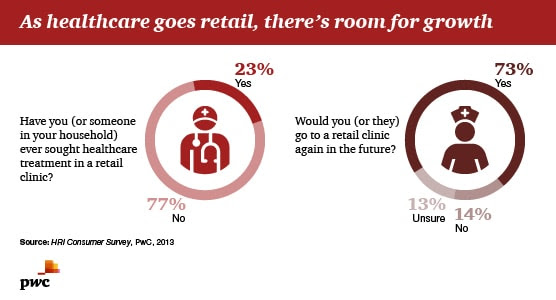
Image provided by PwC's Health Research InstituteMore than ever before, patients are choosing retail clinics for care instead of traditional hospital and physician practice services based on cost and convience, according to a survey from PwC's Health Research Institute.        
Twenty-three percent of respondents sought healthcare treatment in a retail clinic, and 73 percent of them would use that service again, according to an informational graphic (pictured right) provided by PwC's Health Research Institute. The number of people using retail clinics tripled from 2007, when just 9.7 percent used that service, according to another HRI survey of more than 1,000 consumers.
The trend is a result of what patients want to see--more convenient, transparent care, Vaughn Kauffman, health industries principal at PwC told FierceHealthcare in an exclusive interview.

To learn more:
- read the retail clinic survey results            - check out the second HRI survey

Study Finds That Adding Telemonitoring To Support Diabetes Management Did Not Change Patient Outcomes

Adding telemonitoring to routine diabetes care did not significantly change patient outcomes, according to a new AHRQ-funded study. The study, “Effect of Home Telemonitoring on Glycemic and Blood Pressure Control in Primary Care Clinic Patients with Diabetes,” appeared online January 3 in Telemedicine and e-Health. Researchers compared 53 people who received routine care with 55 people who got routine care plus telemonitoring. After 12 weeks of care, hemoglobin A1c and blood pressure levels were not significantly different between the two groups. The study findings and abstract suggest that the addition of technology alone is unlikely to lead to improved outcomes, and that telemonitoring should be limited to patients whose care plans change significantly. The study said more research is needed to determine how primary care practices can effectively use telemonitoring to support patients’ abilities to manage diabetes.

Aetna now reimburses for iRhythm’s ZIO Patch

iRhythm Zio PatchAetna will now reimburse for iRhythm’s ZIO Patch, a continuous long-term heart monitor worn on an adhesive patch. The insurer recently updated its Clinical Policy Bulletin on cardiac event monitors, upgrading the ZIO Patch from “experimental and investigational” to “medically necessary” for certain conditions.
Dr. Eric Topol at the Scripps Translational Science Institute published research just this month that compared the ZIO Patch to traditional Holter monitors. Topol found that the devices performed comparably and the ZIO patch was preferred by patients and doctors.   More

Studies Assess Factors Associated With Telehealth Adoption, Use

Two studies published in the journal Health Affairs examine the use of telehealth. One study finds that patients who use telehealth are typically more affluent, technology savvy and younger. The other study finds that states' policies affect whether hospitals offer telehealth services. Modern Healthcare, FierceHealthIT. Read More

HHS Final Rule Gives Patients Direct Access to Lab Results

Yesterday, HHS released a final rule that amends the Clinical Laboratory Improvement Act and gives patients and their designees -- which could include personal health record systems -- direct access to their laboratory results. HHS and consumer groups say the new rule will empower patients. Washington Post et al.  Read More

AHRQ-Funded Talking Touchscreen® Expanded for New Uses

The Talking Touchscreen®, a multimedia health information technology tool, was developed as a user-friendly way of assessing patient-reported outcomes and as a tool to help end health disparities in underserved populations. The CancerHelp Talking Touchscreen® and DiabetesHelp Talking Touchscreen® have been integrated with the CancerHelp Institute’s patient education programs. Patients now have access to information from AHRQ, the National Cancer Institute and the National Institute of Diabetes and Digestive and Kidney Diseases on treatment, support, side effects and screening. 

The Talking Touchscreen framework has also been built into an application called Health LiTT (available at http://www.healthlitt.org External Web Link Policy), a measure of health literacy that can be self-administered in either English or Spanish using sound, text, and images. It covers health- and insurance-related topics and informed consent. The Talking Touchscreen/La Pantalla Parlanchina and Health LiTT have also been incorporated into Assessment Center, a free online research management tool that helps researchers create study-specific Web sites for securely capturing participant data (available at http://www.assessmentcenter.net External Web Link Policy). By overcoming assessment barriers to self-administration of questionnaires, these tools enable new insight into previously undetected disease or treatment problems among low literacy patients, and also enable real-time reporting of health literacy scores.
The CancerHelp-Talking Touchscreen is available at http://www.cancerhelp.org External Web Link Policy.

To learn more about how this innovative tool is helping patients, read the Impact Case Study at: http://www.ahrq.gov/policymakers/case-studies/cp31312.html. 

AHRQ Update on HIT Research Activities

Health Information Technology

Electronic health records can lower prescribing errors
Health information exchange reduces use of repeated diagnostic imaging for back pain
Resident, attending faculty physicians find patient portal experiences not what they expected

Report Evaluates Role of Social Media in Chronic Disease Care

A new report from the eHealth Initiative finds that social media could help alleviate the burden of chronic disease on the U.S. health care system. However, the report notes that several challenges -- including privacy concerns, gaps in social media adoption and the quality of online information -- must be addressed. Government Health IT, eHI release. Read More

For the report, researchers conducted a literature review, as well as an environmental scan that included case studies and interviews.
The California HealthCare Foundation provided support for the report. CHCF publishes iHealthBeat.
The report found that social media can help individuals with chronic diseases:
  • Achieve personal goals;
  • Correct high-risk behavior; and
  • Better manage their conditions.
It also noted that social media tools offer a unique social network of support, motivation and education.
However, the report identified several challenges that must be addressed to fully leverage social media in chronic disease care, including:
  • Balancing transparency and anonymity;
  • Concerns about privacy and HIPAA compliance;
  • The digital divide among elderly and minority populations; and
  • Quality, validity and authenticity of online information.

Other Nursing Informatics & HIT Blogs of Interest

Nursing Informatics & Technology: A Blog for All Levels of Users

News from healthcareitnews.com

mobihealthnews

iHealthBeat

Health information technology improves care and saves lives

AHRQ Research about: * Telemedicine * School Health * Health Maintenance

Ethics and HIT

Challenges...
http://jamia.bmj.com/site/icons/amiajnl8946.pdf
  • patient safety should trump all other values; corporate concerns about liability and intellectual property ownership may be valid but should not over-ride all other considerations;
  • transparency and a commitment to patient safety should govern vendor contracts;
  • institutions are duty-bound to provide ethics education to purchasers and users, and should commit publicly to standards of corporate conduct; and
  • vendors, system purchasers, and users should encourage and assist in each others’ efforts to adopt best practices.

e-Behaviorial Health


Benefit from new technologies... enable people to have remote access to CBT

Jump to Featured Quality Tools