AHRQ’s Health Care Innovations Exchange Focuses on Community-Wide Initiatives To Enhance Access for Vulnerable Populations
The latest issue of AHRQ’s Health Care Innovations Exchange features three profiles about community-wide initiatives to increase access to health care for vulnerable populations. One featured profile
describes a community-funded, nonprofit organization called Doctors
Care that matches eligible uninsured and underinsured patients in a
three-county area outside of Denver County, CO, with providers who agree
to serve them at a discounted rate. High levels of participation among
area providers and enhanced patient access to care has led to a 15
percent rate of emergency department visits by Doctors Care patients,
well below the 21 percent national average for uninsured patients. Other
innovation profiles and tools
related to collaborative efforts to enhance access for vulnerable
populations are located on the Innovations Exchange Web site, which
contains more than 825 searchable innovations and 1,550 quality tools.

Studies Show Computerized Decision Tools Can Aid Acute Coronary Syndrome, Pulmonary Embolism Diagnoses
New AHRQ-funded research finds that computerized diagnostic
testing can help clinicians assess whether their patients are suffering
serious, acute cardiovascular events such as heart attacks.
Traditionally, pretest probability assessment—in which clinicians use
their experience to discern whether a patient is in danger—has played a
central role in diagnosis. This clinical judgment, or “doctor’s best
guess,” can help reduce unnecessary and dangerous testing. However,
pretest probability assessment is imperfect for ruling out acute
coronary syndrome [ACS] (which includes heart attack and unstable
angina) and pulmonary embolism [PE] (a sudden blockage in the lung
artery). One AHRQ-funded paper, published in Annals of Emergency Medicine,
found that clinicians routinely overestimated pretest probability of
both ACS and PE compared with computerized pretest methods. A second paper, based on the same study and also published in Annals of Emergency Medicine,
found that patients at very low risk of ACS or PE (less than 2.5
percent) may be able to skip imaging (which is often used to test for
ACS and PE) and reduce their exposure to radiation. A third paper, published in Circulation: Cardiovascular Imaging,
found that computerized pretest probability screening reduces dangerous
and expensive testing (including the risk of radiation exposure) in
low-risk ambulatory patients with symptoms of ACS and PE. This
demonstrates direct benefit of an electronic decision support to aid in
diagnosis. All three papers were based on AHRQ-funded research led by
Jeffrey A. Kline, M.D., from the Department of Emergency Medicine,
Department of Cellular and Integrative Physiology, Indiana University
School of Medicine.
Infographic: 5 Health IT Trends for 2014
Infographic created by CDW Healthcare
illustrates 5 health IT trends that will have a big impact on
healthcare’s increasingly competitive and cost-conscious environment.

Infographic: 5 Health IT Trends for 2014
by Fred Pennic
Source: CDW Healthcare
Apps hospitals create for their patients
Based
on an exhaustive search of Apple’s AppStore and the Google Play store in
September 2013, MobiHealthNews found 205 apps that were
“hospital-branded” and intended for use by consumers or patients.17 percent from children’s hospitals; 30 percent include ER appointment booking; 1 percent are paid apps; 3 percent include fitness trackers or fitness-related features; 61 percent are available for both Android and iOS; 3 percent boast some kind of EHR access Read More
Consumers turn to retail clinics for convenience, affordability
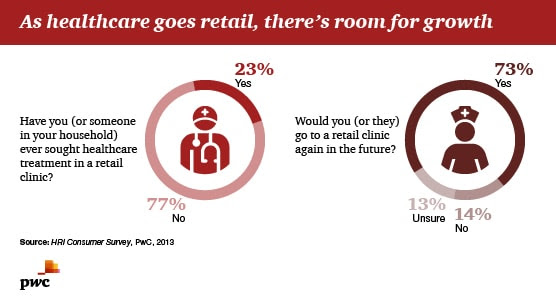 More than ever before, patients are choosing retail clinics for care instead of traditional hospital and physician practice services based on cost and convience, according to a survey from PwC's Health Research Institute.
Twenty-three percent of respondents sought healthcare treatment in a retail clinic, and 73 percent of them would use that service again, according to an informational graphic (pictured right) provided by PwC's Health Research Institute. The number of people using retail clinics tripled from 2007, when just 9.7 percent used that service, according to another HRI survey of more than 1,000 consumers.
The trend is a result of what patients want to see--more convenient, transparent care, Vaughn Kauffman, health industries principal at PwC told FierceHealthcare in an exclusive interview.
To learn more:
- read the retail clinic survey results - check out the second HRI survey
Study Finds That Adding Telemonitoring To Support Diabetes Management Did Not Change Patient Outcomes
Adding telemonitoring to routine diabetes care did not significantly
change patient outcomes, according to a new AHRQ-funded study. The
study, “Effect of Home Telemonitoring on Glycemic and Blood Pressure
Control in Primary Care Clinic Patients with Diabetes,” appeared online January 3 in Telemedicine and e-Health.
Researchers compared 53 people who received routine care with 55 people
who got routine care plus telemonitoring. After 12 weeks of care,
hemoglobin A1c and blood pressure levels were not significantly
different between the two groups. The study findings and abstract
suggest that the addition of technology alone is unlikely to lead to
improved outcomes, and that telemonitoring should be limited to patients
whose care plans change significantly. The study said more research is
needed to determine how primary care practices can effectively use
telemonitoring to support patients’ abilities to manage diabetes.
Aetna now reimburses for iRhythm’s ZIO Patch
 Aetna
will now reimburse for iRhythm’s ZIO Patch, a continuous long-term heart
monitor worn on an adhesive patch. The insurer recently updated its Clinical Policy Bulletin on cardiac event monitors, upgrading the ZIO Patch from “experimental and investigational” to “medically necessary” for certain conditions.
Dr. Eric Topol at the Scripps Translational Science Institute published research just this month that compared the ZIO Patch to traditional Holter monitors. Topol found that the devices performed comparably and the ZIO patch was preferred by patients and doctors. More
Studies Assess Factors Associated With Telehealth Adoption, Use
Two studies published in the journal Health Affairs examine the
use of telehealth. One study finds that patients who use telehealth are
typically more affluent, technology savvy and younger. The other study
finds that states' policies affect whether hospitals offer telehealth
services. Modern Healthcare, FierceHealthIT. Read More
HHS Final Rule Gives Patients Direct Access to Lab Results
 Yesterday, HHS released a final rule
that amends the Clinical Laboratory Improvement Act and gives patients
and their designees -- which could include personal health record
systems -- direct access to their laboratory results. HHS and consumer
groups say the new rule will empower patients. Washington Post et al. Read More
AHRQ-Funded Talking Touchscreen® Expanded for New Uses
The Talking Touchscreen®,
a multimedia health information technology tool, was developed as a
user-friendly way of assessing patient-reported outcomes and as a tool
to help end health disparities in underserved populations. The
CancerHelp Talking Touchscreen® and DiabetesHelp Talking Touchscreen®
have been integrated with the CancerHelp Institute’s patient education
programs. Patients now have access to information from AHRQ, the
National Cancer Institute and the National Institute of Diabetes and
Digestive and Kidney Diseases on treatment, support, side effects and
screening.
The Talking Touchscreen framework has also been built into an application called Health LiTT (available at http://www.healthlitt.org ),
a measure of health literacy that can be self-administered in either
English or Spanish using sound, text, and images. It covers health- and
insurance-related topics and informed consent. The Talking
Touchscreen/La Pantalla Parlanchina and Health LiTT have also been
incorporated into Assessment Center, a free online research management
tool that helps researchers create study-specific Web sites for securely
capturing participant data (available at http://www.assessmentcenter.net ).
By overcoming assessment barriers to self-administration of
questionnaires, these tools enable new insight into previously
undetected disease or treatment problems among low literacy patients,
and also enable real-time reporting of health literacy scores.
The CancerHelp-Talking Touchscreen is available at http://www.cancerhelp.org.
To learn more about how this innovative tool is helping patients, read the Impact Case Study at: http://www.ahrq.gov/
The Talking Touchscreen framework has also been built into an application called Health LiTT (available at http://www.healthlitt.org
),
a measure of health literacy that can be self-administered in either
English or Spanish using sound, text, and images. It covers health- and
insurance-related topics and informed consent. The Talking
Touchscreen/La Pantalla Parlanchina and Health LiTT have also been
incorporated into Assessment Center, a free online research management
tool that helps researchers create study-specific Web sites for securely
capturing participant data (available at http://www.assessmentcenter.net ).
By overcoming assessment barriers to self-administration of
questionnaires, these tools enable new insight into previously
undetected disease or treatment problems among low literacy patients,
and also enable real-time reporting of health literacy scores.The CancerHelp-Talking Touchscreen is available at http://www.cancerhelp.org
.To learn more about how this innovative tool is helping patients, read the Impact Case Study at: http://www.ahrq.gov/
AHRQ Update on HIT Research Activities
Health Information Technology
Electronic health records can lower prescribing errorsHealth information exchange reduces use of repeated diagnostic imaging for back pain
Resident, attending faculty physicians find patient portal experiences not what they expected
Report Evaluates Role of Social Media in Chronic Disease Care
 A new report from the eHealth Initiative
finds that social media could help alleviate the burden of chronic
disease on the U.S. health care system. However, the report notes that
several challenges -- including privacy concerns, gaps in social media
adoption and the quality of online information -- must be addressed. Government Health IT, eHI release. Read More
For the report, researchers conducted a literature review, as well as an environmental scan that included case studies and interviews.
The California HealthCare Foundation provided support for the report. CHCF publishes iHealthBeat.
The report found that social media can help individuals with chronic diseases:
- Achieve personal goals;
- Correct high-risk behavior; and
- Better manage their conditions.
However, the report identified several challenges that must be addressed to fully leverage social media in chronic disease care, including:
- Balancing transparency and anonymity;
- Concerns about privacy and HIPAA compliance;
- The digital divide among elderly and minority populations; and
- Quality, validity and authenticity of online information.
Example of an app that can cheer you up and make monitoring your blood sugar easier
MySugr Diabetes Companion is one of many Apps that makes it easy to record and track your blood-sugar levels.
When you check your blood sugar, you can record your levels in MySugr. You can add emotion badges to record if you were feeling sleepy, grumpy or other things.
 You can also track what you eat through MySugr by taking photos of
your food. Your results are then turned into easy-to-read graphs that
document your blood-sugar levels. And when you need to show the doctor
your results, you can easily print out your information right from the
app.
One of my favorite features is the MySugr monster. Your daily results affect the monster, so it makes it a fun and motivational way to monitor your levels.
Links:
play.google.com/store/apps/details?id=com.mysugr.android.companion
When you check your blood sugar, you can record your levels in MySugr. You can add emotion badges to record if you were feeling sleepy, grumpy or other things.
You can also track what you eat through MySugr by taking photos of
your food. Your results are then turned into easy-to-read graphs that
document your blood-sugar levels. And when you need to show the doctor
your results, you can easily print out your information right from the
app.One of my favorite features is the MySugr monster. Your daily results affect the monster, so it makes it a fun and motivational way to monitor your levels.
Links:
play.google.com/store/apps/details?id=com.mysugr.android.companion
Australian researchers sum up risks with medical apps
 Concerns are broken down into four key categories: infrastructure, distracters, privacy and security, and app developers.
The first group relates to the network infrastructure at a healthcare facility or wherever the healthcare provider is aiming to use medical apps. Of course, without a cell signal, most medical apps won’t work. The researchers also note that some hospital set-ups could have bandwidth issues if too many healthcare providers are attempting to use apps simultaneously.
Distraction-related issues that the researchers noted include email sign ups, pop-ups, icons/badges, notifications, and email alerts. The distractibility of other apps resident on mobile devices has been a concern for many years. The patient’s perception that a medical profession may not be paying attention to them and making eye contact because they are using a medical app is a related concern.
The researchers cite concerns about medical app developers. Developers may lack an understanding of healthcare contexts and standards. They may be using data mining tools as mentioned above. They may also have included very little (if any) end user input during the design of their apps, which could lead to safety risks and inaccurate information or algorithms.
While the researchers’ concerns shouldn’t be new to longtime mobile health watchers, the report sums them up tidily. The entire January edition of the medical journal, which focused on mobile health regulation, is available for free as a PDF right now.
EHRs Could Divert Too Much Doctor Attention

Nonverbal cues may get overlooked and affect doctors’
ability to pay attention and communicate with patients when physicians
spend too much time looking at the computer screen in the exam according
to a Northwestern Medicine study.
Among the most important factors are physicians’ communication skills
and their individual style of interacting with patients. In addition,
the culture of the health care organization can affect implementation
and use of EHRs in patient-physician interactions.
Removing spatial barriers, such as installing mobile monitors or
configuring examination rooms to enable physicians to maintain eye
contact while using the computer and allow patients to view the computer
screen easily can help promote "inclusive" use of computers in clinical
encounters, the report concluded. Read More
Studies show positive health effects from patient-doctor communication
A team
of Dutch scientists has conducted a review of published studies that
looked at how electronic communication between doctors and patients —
like email or messaging through a patient-facing EHR portal — affects
care outcomes, health behavior, and patient satisfaction. In the paper,
recently published in the Journal of Medical Internet Research,
researchers looked particularly at studies focused on chronically ill
patients.
Keep reading>>
Keep reading>>
Researchers Study Impact of Diabetes Telemonitoring in Patient-Centered Medical Homes
New AHRQ-funded research uncovered important implementation
considerations for telemonitoring of blood glucose and blood pressure in
diabetes patients receiving care in patient-centered medical homes. The
article and abstract,
“Implementing Home Blood-Glucose and Blood-Pressure Telemonitoring in
Primary Care Practices for Patients With Diabetes: Lessons Learned,”
appeared online December 18 in Telemedicine and E-Health.
Researchers gathered perspectives from stakeholders, including
patients, nurse care coordinators, and physicians, to understand the
impact of using information technology to monitor diabetes patients from
a distance. Stakeholders emphasized the need to involve and prepare
physicians and patients about how to effectively use telemonitoring.
They also stressed the importance of considering workflows, flow of
information, and human factors to optimize use of the technology.
Despite risks, patients want to share data
 A survey
of 2,125 adults with health conditions who are already members of
PatientsLikeMe found that 94 percent of adults would be willing to share
their health information on social media if it helps doctors improve
care even though a majority of those surveyed also understand the data
could also be used negatively. The survey was done in partnership with
the Institute of Medicine.
Keep reading>>
National Compendium of Best Practices in Telehealth Services
The California Telehealth Resource Center has compiled a lengthy list of telehealth best practices. As you begin….Lessons from the field
 This document provides a complete compendium of best practices
developed from CTRC’s 10 year experience developing telehealth programs
and added to by a panel of telehealth experts from across the country.
This document provides a complete compendium of best practices
developed from CTRC’s 10 year experience developing telehealth programs
and added to by a panel of telehealth experts from across the country.“Often overlooked, the sharing of what works and what doesn’t is very important!”Read More
– James Marcin, MD, MPH, Director, Pediatric Telemedicine
UC Davis Children’s Hospital
3 best practices for "selling" telehealth and mHealth | How to bridge the 9x gap
Inside Hands On Telehealth
The illustration below, taken from the original HBR article, helps to visualize the gap.Thanks to a recent interview with Dr. Saif Abed of Abed Graham Healthcare Strategies, I came across a fascinating article in Harvard Business Review (HBR) entitled “Eager Sellers and Stony Buyers.”
It discusses why people have such a hard time accepting/adopting a new product or service as compared to the one they already have in place.
Read More

Gender, Personality Affect Medical Students' EHR Perceptions
A new study finds that gender and personality traits affect how medical
students perceive the usefulness and usability of electronic health
record systems. For example, the study finds that male medical students
were more likely than female students to report that EHRs are easy to
use. Clinical Innovation & Technology et al.More
Sites for medical resources
All of these sites have something unique and helpful to offer, so be sure to look at each one. Just remember that these sites are not substitutions for a real doctor's advice.
Ask A Patient - Do you really know what you're in for when you take medication? Medical science has come a long way, but sometimes medication cons outweigh the pros.
This site is for anyone who is worried about trying a new physician-prescribed medication. You can look through reviews from real people about the experiences (positive and negative) they've had on doctor-prescribed medication to make more educated decisions. Just remember to take everything on this site with a grain of salt.
LongTermCare.gov - For those of you who worry about aging parents or grandparents, this is a great site to start planning for the future. Planning for that sort of thing is easy to put off, but if you don't think about the future, you may be left high and dry if trouble strikes.
This site answers questions about long-term care for your loved ones like the difference between Medicare and Medicaid, and long-term care versus custodial care. The more information you have, the better the chance will be that you make the best decision for your loved ones.
PDR Health - Asking other people about their experiences can be helpful, but when it comes to the medical field it's important to listen to your doctor. After all, they do have years of medical training.
Physicians' Desk Reference has a huge database of medication information, as well as information about diseases, conditions, and what you should avoid when taking medications.
Hospitals rank alarm fatigue as top patient safety concern
Nineteen out of 20 hospitals surveyed rank alarm fatigue as a top patient safety concern, according to the results of a national survey presented last week at the annual meeting of the Society for Technology in Anesthesia.
Alarm fatigue occurs when clinicians become desensitized to the constant noise of alarms or overwhelmed by the sounds and turn alarms down or off. The problem has become so widespread that last month The Joint Commission named it a National Patient Safety Goal and now requires accredited hospitals and critical access hospitals to improve their systems.
Related Articles:
Monitor adjustments reduce alarm fatigue at Boston hospital
Patient safety goal aims to end clinical alarm fatigue
Alarm fatigue tops health technology hazards list
Patient death attributed to alarm fatigue, sounding alarm in nation
Patients continually put in danger due to alarm fatigue
Read more about: National Patient Safety Goal
Telestroke: Improving Stroke Care for Rural Arizona Residents
Telestroke: Improving Stroke Care for Rural Arizona Residents
By Jane Erikson on Jan 21, 2014 03:41 pm
In 2005, patients who were hospitalized with an ischemic stroke
in Tucson or Phoenix were 10 times as likely to receive potentially
life-saving medical care as patients treated at hospitals in rural
Arizona.
Today, patients in rural Arizona have as good or even better chance of receiving the best possible treatment – a “clot-busting” drug called tPA - compared with stroke patients in the state’s two largest cities.
The change came about because of the Telestroke Program at the Mayo Clinic – Phoenix.
Today, patients in rural Arizona have as good or even better chance of receiving the best possible treatment – a “clot-busting” drug called tPA - compared with stroke patients in the state’s two largest cities.
The change came about because of the Telestroke Program at the Mayo Clinic – Phoenix.
Read more »
PSFK presents Future Of Health
PSFK presents Future Of Health from PSFK
Advances in technology are allowing for the provision of affordable, decentralized healthcare for the masses and are lowering the barriers to entry in less developed markets.
The analysis in PSFK’s Future of Health Report has yielded a number of insights, the most evident of which is mobile technology as a catalyst for change. The mobile phone and connected tablet computer are allowing for the distribution of a broad range of medical and support services. This is especially important in countries with little or no healthcare infrastructure and areas in which there are few trained healthcare professionals. These technologies also allow trained professionals to perform quality control remotely.
SAFER Guides help optimize safe use of EHRs
 A
new set of guides and interactive tools designed to help health care
providers use electronic health records (EHRs) more safely has been
released by the Department of Health and Human Services’ Office of the
National Coordinator for Health Information Technology (ONC). The SAFER Guides
are a suite of tools that include checklists and recommended practices
to help health care providers assess and optimize the safety and safe
use of EHRs.
The
SAFER Guides complement AHRQ’s existing safety tools and research.
AHRQ’s Patient Safety Organizations have identified health IT as a high
priority given the impact EHRs are having on patient safety right now.
AHRQ has a wide variety of health IT tools and resources to help
implement and use Health IT safely including the Health IT Hazard Manager, the Workflow Assessment for Health IT Toolkit, Implementation Tools for E-Prescribing, Consumer Health IT Design Guide, and the Guide to Reducing Unintended Consequences of EHRs.
Deloitte’s four P’s for mobile health best practices
 Mobile
health strategies shouldn’t be one-size-fits-all, Dr. Harry Greenspun,
Deloitte’s Senior Advisor on Health Care Transformation and Technology,
wrote in a recent blog post. There are four dimensions that need to be
considering in developing a mobile health intervention or technology.
Greenspun breaks down the focus areas into four P’s: People, Payment,
Places, and Purpose. More
Telemonitoring to Support Diabetes Management in Patient Centered Medical Homes
New
research supported by the Agency for Healthcare Research and Quality
(AHRQ) uncovered important implementation considerations for
telemonitoring of blood glucose and blood pressure in diabetes patients
receiving care in patient-centered medical homes. “Implementing home
blood-glucose and blood-pressure telemonitoring in primary care
practices for patients with diabetes: Lessons Learned,” appeared online
December 18, 2013 in Telemedicine and e-health. Researchers
gathered perspectives from stakeholders including patients, nurse care
coordinators, and physicians to understand the impact of telemonitoring
diabetes in primary care practices. Stakeholders emphasized the need to
involve and prepare physicians and patients to effectively use
telemonitoring. They also stressed the importance of considering
workflows, flow of information, and human factors to optimize use of the
technology.
Select to access the abstract: http://www.ncbi.nlm.nih.gov/
IOM Seeks To Help Providers Assess EHR Costs, Benefits
 The Institute of Medicine has released a
proposed model aimed at helping hospitals and other health care
providers evaluate the costs and benefits of implementing electronic
health record systems by making comparisons among organizations and
identifying best practices. FierceEMR et al.
Subscribe to:
Posts (Atom)
e-Behaviorial Health
Benefit from new technologies... enable people to have remote access to CBT
